Deep Residual Shrinkage Network yaa Deep Residual Network sẽn maneg n yɩɩda. Sã n yaa a võore, Deep Residual Shrinkage Network wã lagimda Deep Residual Network, attention mechanisms, la soft thresholding functions n tʋmdẽ.
D tõe n bãnga Deep Residual Shrinkage Network tʋʋmde woto: Pipi, network wã tũnuga ne attention mechanisms n bãng features nins sẽn pa tar yõodo. Rẽ poore, network wã tũnuga ne soft thresholding functions n rɩk unimportant features kãens n lebg zero. La sã n yaa important features wã, network wã bãngda bãmba, n bas-b tɩ b looge. Tʋʋm-kãngã kenga deep neural network wã pãnga. A sõngda network wã t’a yiis useful features nins sẽn be signals wã pʋgẽ, baa ne noise sẽn be a pʋgẽ wã.
1. Research Motivation
Pipi, noise wã yaa bũmb d sẽn pa tõe n gĩ ne, sã n yaa tɩ algorithm wã maand classify ne samples. Noise kãngã buud yaa wala Gaussian noise, pink noise, la Laplacian noise. Sã n yaa ne pãng sẽn yɩɩd woto, samples wã nod n tara kibay sẽn pa tar yõod ne classification task wã. D tõe n gesa kibay kãens wa noise. Noise kãngã tõe n kɩtame tɩ classification performance wã lʋɩ tẽng wʋsgo. (Soft thresholding yaa tʋʋm-kãng sẽn tar yõod wʋsg signal denoising algorithms wʋsg pʋgẽ.)
Bɩ d rɩk makre: d sã n sosd sor noli. Koɛɛgã tõe n tara mobili-dãmb wiis la b rũms goama. D sã n dat n maan speech recognition ne signals kãense, bũmb nins sẽn be poorẽ wã na n kɩtame tɩ tʋʋmdã pa yɩ sõma ye. D sã n ges deep learning nifẽ, deep neural network wã segd n yisa features nins sẽn yaa mobili-dãmb wiis la b rũmsã. Yaa woto la d tõe n gidi features kãens tɩ b ra paam pãng speech recognition wã zutu ye.
Yiib-n-soaba, noise wã sõor pa yembre ne samples wã fãa ye. Bũmb kãngã maanda woto baa dataset a ye pʋgẽ. (Yɛl kãens tara wʋsg n naag ne attention mechanisms. Bɩ d rɩk image dataset n maan makre. Bõn-ning d sẽn dat n gese, a zĩig tõe n yaa toor ne images wã fãa. Attention mechanisms wã tõe n kenga a nif ne zĩig ninga d sẽn dat n ges image fãa pʋgẽ.)
Bɩ d rɩk makre: d sã n train cat-and-dog classifier ne images a nu sẽn tar “dog” label. Image 1 tõe n tara baa ne dayuug-bila. Image 2 tõe n tara baa ne no-yɛɛga. Image 3 tõe n tara baa ne noaaka. Image 4 tõe n tara baa ne bõnga. Image 5 tõe n tara baa ne larde. Training wã sasa, bõn-kãens sẽn pa tar yõod wã na n kɩtame tɩ classifier wã pa tʋm sõma ye. Bõn-kãens yaa dayuug-bila, no-yɛɛga, noaaka, bõnga, la larde. Woto kɩtdame tɩ classification accuracy wã lʋɩ tẽnga. D sã n tõog n bãng bõn-kãens nins sẽn pa tar yõodo, d tõe n yiisa features nins sẽn yaa b rẽndã. Woto, d tõe n kenga cat-and-dog classifier wã accuracy t’a yɩ sõma wʋsgo.
2. Soft Thresholding
Soft thresholding yaa tʋʋm-kãng sẽn tar yõod wʋsg signal denoising algorithms wʋsg pʋgẽ. Algorithm wã yiisda features wã sã n yaa tɩ absolute values wã pa ta threshold wã. Algorithm wã maanda shrinks features wã n dɩk n kẽng zero nifẽ, sã n yaa tɩ absolute values wã yɩɩda threshold wã. Researchers wã tõe n tũnuga ne formula kãngã n maan soft thresholding:
\[y = \begin{cases} x - \tau & x > \tau \\ 0 & -\tau \le x \le \tau \\ x + \tau & x < -\tau \end{cases}\]Soft thresholding output wã derivative ne a input wã yaa:
\[\frac{\partial y}{\partial x} = \begin{cases} 1 & x > \tau \\ 0 & -\tau \le x \le \tau \\ 1 & x < -\tau \end{cases}\]Formula kãngã sẽn be yĩngrã wilgdame tɩ soft thresholding wã derivative yaa 1 bɩ 0. Bũmb kãngã yaa woto wa ReLU activation function wã me. Woto yĩnga, soft thresholding wã tõe n kɩtame tɩ gradient vanishing la gradient exploding ra yɩ yɛl-kãseng deep learning algorithms wã pʋgẽ ye.
Soft thresholding function wã pʋgẽ, d sã n dɩk threshold wã, a segd n tũu conditions a yiibu. Pipi, threshold wã segd n yaa positive number. Yiib-n-soaba, threshold wã pa segd n yɩɩd input signal wã maximum value ye. Sã n pa woto, output wã fãa na n lebga zero.
Sẽn paase, threshold wã segd n tũu condition a tãab-n-soaba. Sample fãa segd n tara a threshold a to, n tũ ne noise wã sõor sẽn be sample kãngã pʋgẽ.
A võor yaa tɩ noise wã sõor pa yembre ne samples wã fãa ye. Wala makre, Sample A tõe n tara noise bilfu, tɩ Sample B tar noise wʋsg dataset a ye pʋgẽ. Zĩig kãngã, Sample A segd n tũnuga ne threshold sẽn yaa bilfu soft thresholding wã sasa. Sample B segd n tũnuga ne threshold sẽn yaa kãsenga. Deep neural networks wã pʋgẽ, baa ne features la thresholds wã sẽn pa tar physical definitions sẽn yaa vẽeneg wã, a tʋʋmdã võor yaa yembre. Woto yĩnga, sample fãa segd n tara independent threshold. Noise wã sõor n na n wilg tɩ threshold wã yaa kãseng bɩ a yaa bilfu.
3. Attention Mechanism
Researchers wã tõe n bãnga attention mechanisms wã võor nana-nana computer vision tʋʋmdã pʋgẽ. Rũmsã visual systems tõe n bãnga bõn-nins b sẽn dat n gesã, n gese zĩigã fãa tao-tao. Rẽ poore, visual systems wã ningda attention bõn-kãngã zugu. Tʋʋm-kãngã kɩtdame tɩ systems wã paam kibay wʋsg n paase. Sasa kãngã me, systems wã gida kibay nins sẽn pa tar yõod wã. Sã n yaa ne a kɛlgre, bɩ y ges literature nins sẽn gomd attention mechanisms wã yelle.
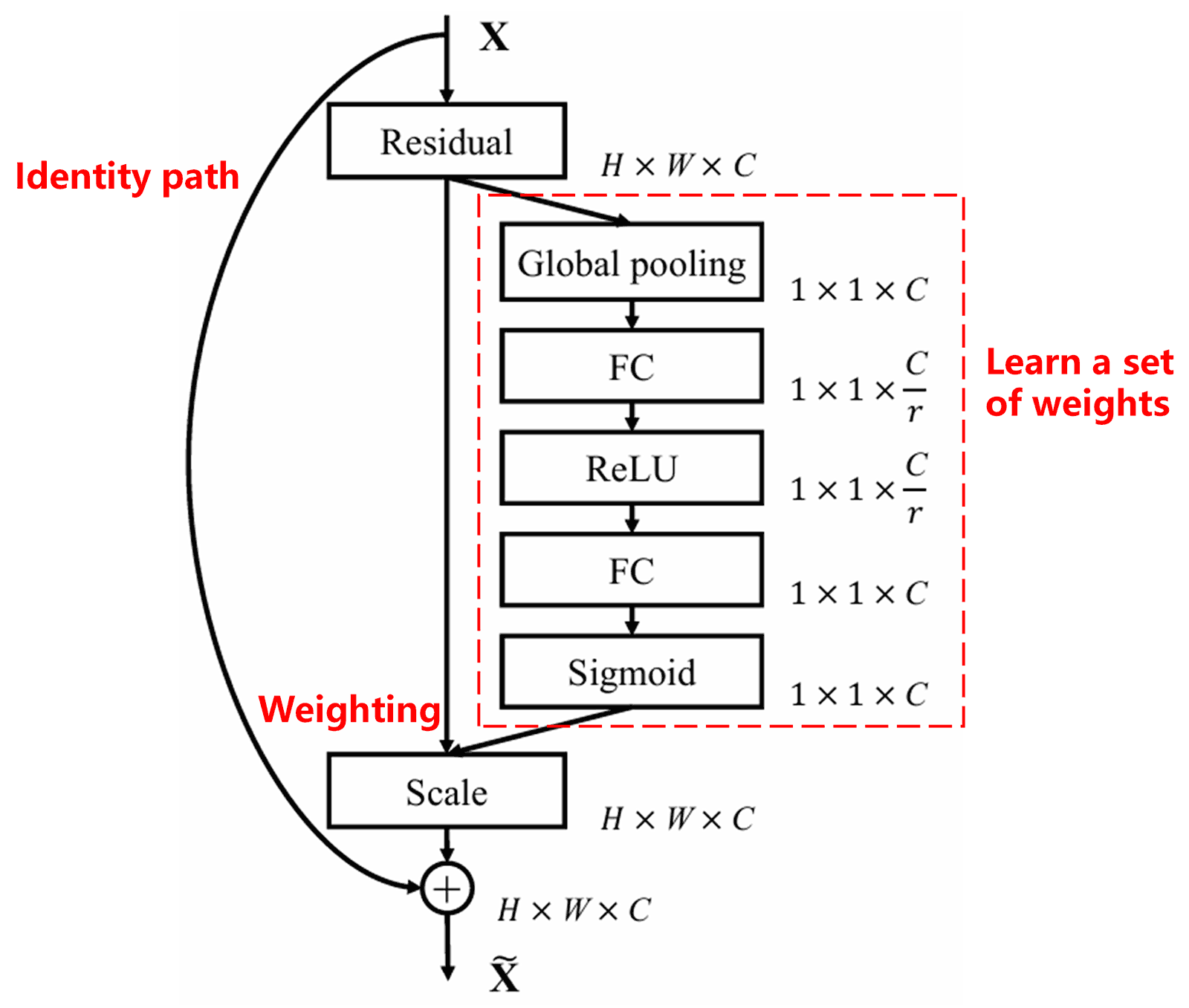
Squeeze-and-Excitation Network (SENet) yaa deep learning method sẽn yaa paalgo, n tũnugd ne attention mechanisms. Samples toor-toor pʋgẽ, feature channels toor-toor sõngda classification task wã ne sore toor-toore. SENet tũnugda ne sub-network bilf n paam a set of weights. Rẽ poore, SENet wã maanda Apply weighting to each feature channel (paasda features wã pãng ne weights wã). Tʋʋm-kãngã teenda features wã pãnga channel fãa pʋgẽ. D tõe n gesa tʋʋm-kãngã wa d sẽn ningd attention sẽn yaa toor-toor ne feature channels toor-toor zutu.
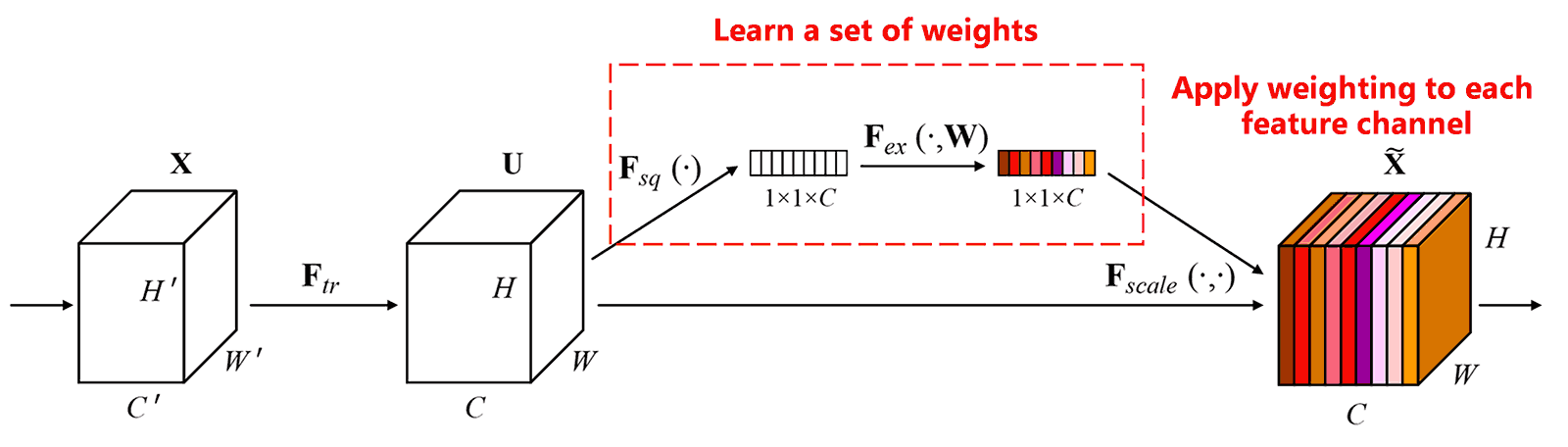
Sore kãngã pʋgẽ, sample fãa tara independent set of weights. Woto yĩnga, samples a yiib weights pa yembre ye. SENet pʋgẽ, sore ning b sẽn tũnugd n paamd weights wã yaa: “Global Pooling → Fully Connected Layer → ReLU Function → Fully Connected Layer → Sigmoid Function”.
4. Soft Thresholding with Deep Attention Mechanism
Deep Residual Shrinkage Network wã tũnugda ne SENet sub-network wã structure. Network wã tũnugda ne structure kãngã n maan soft thresholding ne deep attention mechanism. Sub-network wã (sẽn be red box pʋgẽ wã) maanda Learn a set of thresholds. Rẽ poore, network wã maanda soft thresholding ne feature channel fãa, n tũnugd ne thresholds kãense.
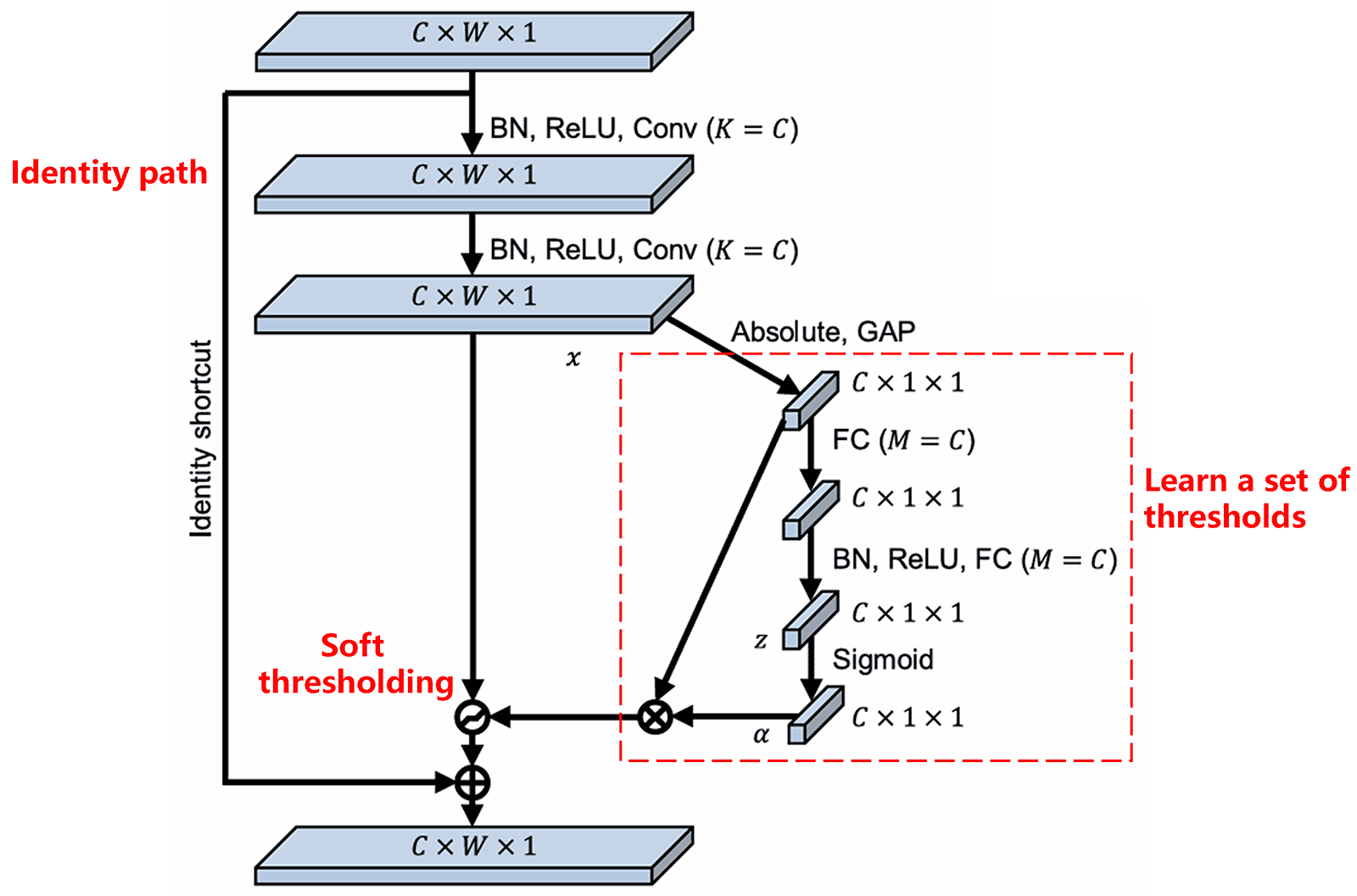
Sub-network kãngã pʋgẽ, system wã rengd n maanda calculate ne absolute values nins fãa sẽn be input feature map wã pʋgẽ. Rẽ poore, system wã maanda global average pooling la averaging n paam feature a ye, tɩ d boond-a tɩ A. Sore a to wã pʋgẽ, system wã maanda input feature map wã ne fully connected network bilfu, global average pooling wã poore. Fully Connected network kãngã tũnugda ne Sigmoid function wa a layer sẽn baasdã. Function kãngã maanda normalizes the output 0 la 1 suka. Tʋʋm-kãngã wata ne coefficient a ye, tɩ d boond-a tɩ α. D tõe n wilga final threshold wã wa α × A. Woto yĩnga, threshold wã yaa sõor a yiib la b lagem n “multiply”. Sõor a ye be 0 la 1 suka. Sõor a to wã yaa average ne absolute values nins sẽn be feature map wã pʋgẽ. Sore kãngã kɩtdame tɩ threshold wã yaa positive. Sore kãngã me kɩtdame tɩ threshold wã pa kãseng n loog ye.
Sẽn paase, samples toor-toor kɩtdame tɩ thresholds wã yaa toor-toore. Woto yĩnga, d tõe n bãnga method kãngã wa attention mechanism sẽn yaa a toor. Mechanism kãngã bãngda features nins sẽn pa tar yõod ne task wã. Mechanism wã teenda features kãens n lebg sõor sẽn pẽ ne zero, n tũnug ne convolutional layers a yiibu. Rẽ poore, mechanism wã maanda soft thresholding n rɩk features kãens n lebg zero. Bɩ d tõe n yeel tɩ mechanism wã bãngda features nins sẽn tar yõod ne task wã. Mechanism wã teenda features kãens n lebg sõor sẽn zãr ne zero, n tũnug ne convolutional layers a yiibu. Wa a sẽn baasdã, mechanism wã kɩtdame tɩ features kãens looge.
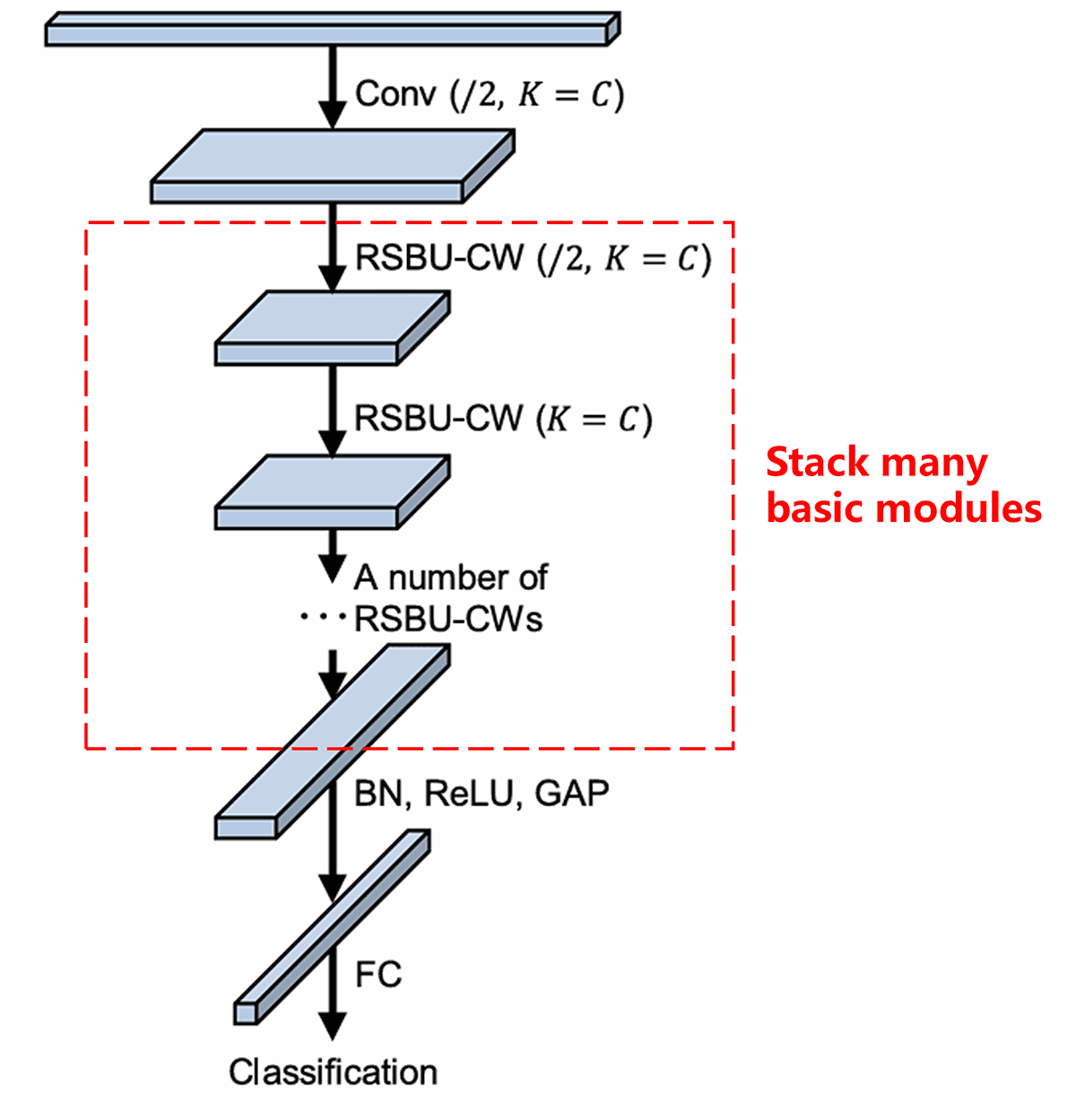
A baasgẽ, d maanda Stack many basic modules (ningd basic modules wã b taab zutu). D le paasda convolutional layers, batch normalization, activation functions, global average pooling, la fully connected output layers. Tʋʋm-kãngã meeda Deep Residual Shrinkage Network wã t’a zems zãng fasɩ.
5. Generalization Capability
Deep Residual Shrinkage Network yaa general method ne feature learning. A võor yaa tɩ feature learning tasks wʋsg pʋgẽ, samples wã mod n tara noise. Samples wã me tara kibay sẽn pa tar yõodo. Noise la kibay kãens sẽn pa tar yõod wã tõe n kɩtame tɩ feature learning wã pa tʋm sõma ye. Wala makre:
Bɩ d ges image classification. Image a ye tõe n tara bõn-naands a taab wʋsg a pʋgẽ. D tõe n gesa bõn-kãens wa “noise”. Deep Residual Shrinkage Network wã tõe n tũnuga ne attention mechanism. Network wã yãta “noise” kãngã. Rẽ poore, network wã tũnugda ne soft thresholding n rɩk features nins sẽn yaa “noise” rẽnda n lebg zero. Tʋʋm-kãngã tõe n kenga image classification accuracy wã.
Bɩ d ges speech recognition. Sẽn yɩɩda fãa sã n yaa zĩig sẽn tar noise wʋsgo, wala sor noli bɩ factory pʋgẽ. Deep Residual Shrinkage Network wã tõe n kenga speech recognition accuracy wã. Bɩ, network wã kõta methodology. Methodology kãngã tara pãng n na n keng speech recognition accuracy wã.
Reference
Minghang Zhao, Shisheng Zhong, Xuyun Fu, Baoping Tang, Michael Pecht, Deep residual shrinkage networks for fault diagnosis, IEEE Transactions on Industrial Informatics, 2020, 16(7): 4681-4690.
https://ieeexplore.ieee.org/document/8850096
BibTeX
@article{Zhao2020,
  author    = {Minghang Zhao and Shisheng Zhong and Xuyun Fu and Baoping Tang and Michael Pecht},
  title     = {Deep Residual Shrinkage Networks for Fault Diagnosis},
  journal   = {IEEE Transactions on Industrial Informatics},
  year      = {2020},
  volume    = {16},
  number    = {7},
  pages     = {4681-4690},
  doi       = {10.1109/TII.2019.2943898}
}
Academic Impact
Paper kãngã paama citations sẽn yɩɩd 1400 Google Scholar zugu.
D sã n ges statistics nins sẽn pa zems zãngã, researchers wã tʋma ne Deep Residual Shrinkage Network (DRSN) publications/studies sẽn yɩɩd 1000 pʋgẽ. Tʋʋm-kãens kẽeda fields wʋsg pʋgẽ. Fields kãens naaga mechanical engineering, electrical power, vision, healthcare, speech, text, radar, la remote sensing.